Signals
TV Distribution can be done using several different types of signals and media.
- Coaxial cabled TV distribution (Analogue and Digital Signals)
- Ethernet (IP-based) cabled TV Distribution
- Wi-Fi (IP-based) wireless TV Distribution
In this Documentation we will solely focus on the first type of Signals (Coaxial cabled TV Distribution).
The TRIAX Design Online Tool allows you to design coaxial and Fibre Optical based TV Distribution Networks, where the transmission media is either a coaxial copper cable, or a singlemode Fibre Optical cable. Normally a TV Distribution Network uses a combination of both, where coaxial cables are the most widely used type of cable.
In the childhood of TV Distribution only analogue Signals were used to carry the signals along the Transmission path from a Transmitter, Over the Air, then to an Antenna, and finally from there over a cable to the TV set. Since the turn of the Century analogue Signals have been gradually phased out, and today nearly all TV Signals are on the Digital domain.
Signals are typically always brought to you and your TV set on a Frequency carrier, where the actual TV Signal is modulated onto the carrier using various modulation types, depending upon the media.
Analogue Modulation types:
- NTSC - National Television Systems Committee Standard. Mainly used in the USA and Japan. The First Analogue modulation type in use.
- SECAM - Sequential Couleur à Mémoire . Mainly a French modulation type used in France and the French colonies.
- PAL - Phase Alternating Line. A Central European alternative to NTSC providing better color seperations and higher resolution.
Digital Modulation types:
- Satellite TV Distribution: QPSK and 8PSK Modulation
Very long distances (38.000 km through space), Large portions of Noise, Large Error Correction Needed. - Terrestrial TV Distribution: COFDM Modulation
Shorter distances (10-30 kilometers through air - over land). Smaller, but still relative large portions of Noise. Medium Error Correction Needed. - Cable TV Distribution: QAM Modulation
Short distances (100-1000 meters, in coaxial cable). Coaxial cable protect well against Noise. Small Error Correction needed.
Signal Bandwidth When you modulate a Signal onto a single Frequency Carrier, you need a few MHz of frequency Bandwidth to do that.
In the Childhood of TV Distribution where everything was black and White TV and lower resolution, a 6 MHz bandwidt per TV channel was selected. This means that for every 6MHz onm the Frequency Range you can have one TV channel.
Also, as low frequencies tend to go further (propagate longer) than high frequencies, the lowest frequencies were used first to transmit over the air. But to make sure TV channels does not interfere with each other over shorter distances, different (higher) frequencies were also used, and as time passed, higher and higher frequencies were taken into use for TV. In fact, former TV frequencies were a bit of a mess as can be seen below.
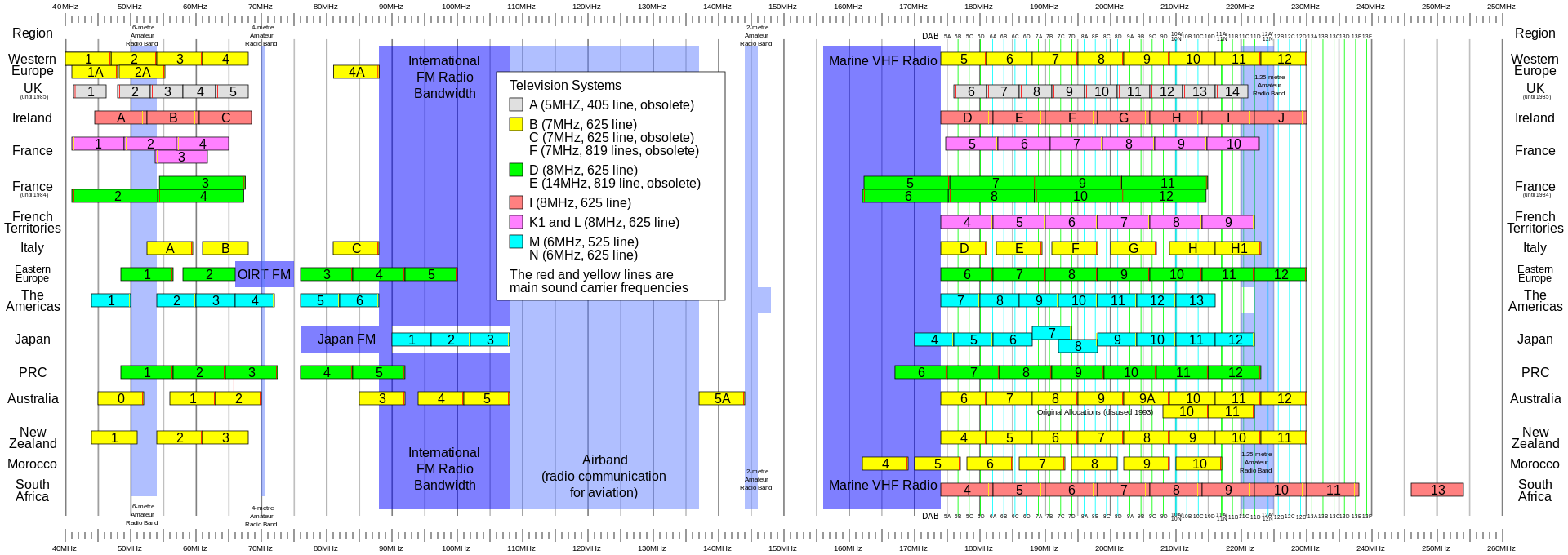 Later came along colour TV, Stereo Audio and higher resolutions, so eventually 8MHz channel Bandwidth were needed and being used.
When you compare with the TV Frequency Bands today, you will see that 6MHz channels are still defined at the lowest end of the Frequency Range, 7MHz in the Middle, and from 306 MHz (TV channel S21) and upwards, all the channels are with 8MHz of channel bandwidth.
Later came along colour TV, Stereo Audio and higher resolutions, so eventually 8MHz channel Bandwidth were needed and being used.
When you compare with the TV Frequency Bands today, you will see that 6MHz channels are still defined at the lowest end of the Frequency Range, 7MHz in the Middle, and from 306 MHz (TV channel S21) and upwards, all the channels are with 8MHz of channel bandwidth.
It is also important to know, that the Frequency and Bandwidth of TV channels varies heavily between parts of the world, and in some cases, even between counties. The TV Signal types modulated upon the Frequency carriers are normally the same types as described above though.
Since the beginning of TV Distribution in the 1950'ies, coaxial cables (also simply called 'coax cables') have been used for TV Distribution, and there are several reasons why this type of cable were selected as transmission media:
- It has two seperate conductors: An inner conductor, with the TV signal, and an outer conductor, a shield, protecting the inner conductor from outside noise and interference.
- It has a characteristic impedance of 75 Ohms (depending upon diameters and dialectricum), which secures the best adaptation between aerials and other components, to secure minimum power loss when transferring signals from one unit to the other.
- It supports a very wide frequency bandwidth, ranging from 5 MHz and up to just below 3 GHz with acceptable losses.
- It is both a transmission media and a shielding device.
- Cables with very low losses (and thick conductors) can be produced without becomming very large and unmanageble, and still maintaining the 75 Ohms Impedance.
- Coax cables can be kept relatively small in diameter (typically 3 to 11mm Ø diameter) allowing the use of small cable distribution pathes.